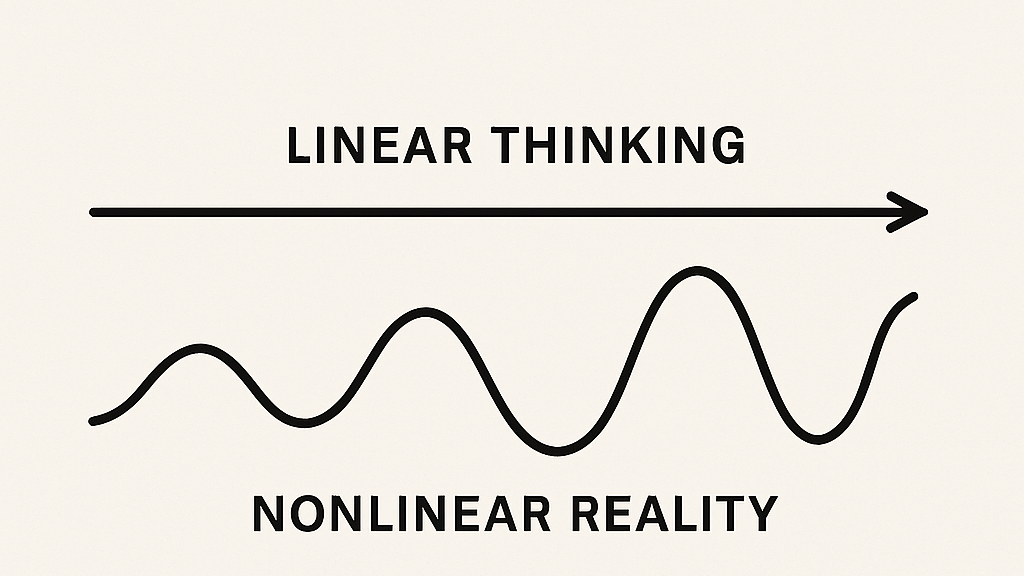
When I was 16yo, I got bored one summer and started reading the Bible. My mother was a missionary, her parents were both ordained pastors, and so I grew up hearing a lot of things *about* God from people who, by rights, should have known what they were talking about. The things they said felt honest, but impersonal. Someone else’s curiosities when I had become aware of my own.
I started with Revelation, the last “official” book of the Christian Bible. Not the first chapter, though. Last book, last chapter. I started at the end, when everything has been (or will be?) blown apart. This wasn’t a mistake. I was intentionally reading backward, receding to everyone else’s rushed reading. I read backward for the next six-ish months until I arrived at Genesis 1:1, at the beginning of all things.
I don’t recommend this.
For a child like me, it felt rebellious. Now, it feels a little silly. “Rebellious”? To read the Bible? How bad of a child must I have been? Maybe this explains, in part, why my absent father would come to tell me that I “wasn’t interesting” until I was an adult.
I’m 44yo now and still think a lot of the things people say *about* the Bible are curious. The things people say are in the Bible to defend their bad behavior still causes me to tilt my head to the side, as though I am able to see their real selves. The ways that people talk *around* the Bible feel more silly now, though, than whatever I thought I was doing when I was 16yo. Students. Adults. Ministers. It’s amusing. And sad. And strange.
I don’t recommend this.
Did I say that already? Lol.
Around that same time, I started doing puzzles upside-down. I would put together these grey or brown puzzles, the color of cheap cardboard or undyed paper, picture face down. I offer this information so you can have a more complete picture. Maybe I was bored. Maybe I was boring, as my father said. Maybe I wanted the challenge. Maybe I was simply a weird kid, I don’t know.
Or maybe that’s what I want you to think. The details we offer about ourselves are something of a costume designed with words. In my experience, so much of what we think we know about someone is really a performance. You have to actually pay attention for the flickers of light and darkness that emerge. You have to pay attention to the small, mundane curves to make sense of them.
It turns out, this isn’t such a crazy idea, playing things out in reverse. And it’s not as strange as it appears at first read.
Several years ago, there was an episode of the sitcom Seinfeld that was told in reverse. You hear the punchline before the joke. You see the consequences of a bad decision the characters made before they make it. The very last scene of the episode is two of the characters meeting years earlier. Unconventional, even annoying to some viewers, but the episode holds together even as it explains larger parts of the characters you thought you knew. When it originally aired, many fans of the show thought it was a strange episode and not at all funny while critics loved it and praised the way it challenged narrative structure.
Time was kind. In reruns and streaming, it became a fan favorite and cult classic, a testament to the brilliance of the show and an example of innovative television that helped bring about a new Golden Age of Television. At least before the fall of the Twin Towers and subsequent War in Afghanistan.
When we read backwards – or even with the last page of a novel in mind – it’s natural we see a story differently. We know the conclusion and are able to notice little things that build toward that conclusion, rather than missing them in a dash to the finish.
Seinfeld, like many shows, seems a relic of an old era. It was also prescient. One of the producers of Seinfeld would go on to become a political operative aligned with Donald Trump. Seinfeld himself, the comedian and not the character, would move through various projects deconstructing his own work and “comedy” as a whole. One of the cast members would have a very public breakdown on stage where he called an audience member a racial epithet. Another would go on to win an Emmy for her role as a bumbling politician, or one who seemed that way in front of cameras, but a failure with her family who was exposed to be more than a little corrupt.
Viewed with the perspective of what came after, reruns tell us a great deal of what is to come. We see the signs, just too late to change anything.
Many of us know what it means to live in the aftermath of destruction.
Is that too strong?
Many of us know what it means to live in the aftereffects of events… of something… of a circumstance brought about through a series ot bad choices, the afterword of a conclusion come too soon. Maybe we feel as though we are moving backwards through life, continually failing rather than ascending. Buckled into an apparatus, facing forward, we hit speed bumps we cannot see. The life we thought we were heading toward gets further out of reach by the mile, even as we see it disappear in front of us. We catch details and see causality after things have already happened, unable to see things in a linear way to make sense of it all. We know what it means to live in the ripples, to start – to start – displaced, to start with destruction rather than bright and fresh, where we belong, with the optimism of… say… a pastoral garden in the beginning, a garden where everything works out as if by magic or through divine providence.
And what does that do to us? To start at the – perhaps too strong a word here, I admit – at the apocalypse rather than the genesis? To start with the revelation of an end instead of communing with nature and the animals?
It may sound a little bit too much, too philosophical for a casual reading right now, but the question lingers at the back of our minds, doesn’t it? Part of a collective wondering. Am I missing something? What the fuck is going on? Not so much “what would we do differently?” although yes, certainly. More of a disassembling, a reverse engineering, an alternative track entirely.
Even today, there was a comic book I was reading where a villain asks Thor, the god of thunder, “I heard you were a god? What is your story like? Does it all end with a rebirth of things? Is there hope? Or is it all apocalypse?” The question was jarring. I thought I was taking a break from this existential ramble, too much in my head and not enough sense when the same question was right there, on the page.
The things we believe in, the things we think will save us… are they all moving toward destruction? Or are they moving toward reconciliation? How does it all end, with a rebirth of things and hope or is it all apocalypse?
Thor hesitates to answer.
He’s not the only one. That was the point of the question, tucked into a safe “immature” comic book.
I’m not the only paren- person wondering the same thing, though, and I suppose Thor is not the only god hesitating to give an answer. “I heard you were a god? What is your story like? Does it all end with a rebirth of things? Is there hope? Or is it all apocalypse?”
Read backward, the Bible stories start to feel like instructions for rebuilding rather than inevitable failure.
Read backward, that is.
Not at first, I admit. At first, it feels messy and chaotic. Confusing and out of sequence. It feels like people are getting it wrong straight away. They never seem to recover. The followers of Jesus are embracing the ways of Empire when (sigh) he specifically asked them not to. And then you move backward, to the early Gospels. There, Jesus is outright what we call “demons” are systems of oppression, Legion, for they are many. Only destruction will come from the evil of Empire.
You keep moving backwards to the Hebrew prophets, who are saying things are about to get reeeally fucked up because Kings and People took things too far in their pursuit of power. Backward again, and you see these same Kings and same People becoming seduced by power. Page by page, read backward, you feel horror and pity. You’ve already seen the outcome. You know now where these decisions will lead. This is where you began the story. Only now, too late, do you see how.
There are those who are living their lives forward who have no idea what I’m talking about right now. They are living their lives in a linear way where everything makes sense. There is no consideration of the consequences. C’est la vie. Carpe diem. No need to overthink things.
There are more, I imagine, who see patterns. Only those patterns are reversed. It is the puzzle put together upside-down, the punchline before the joke. The story told backwards, with causality and not confusion.
We are not looking for a complete image like everyone else. There is no sense in looking for the pretty, colorful picture of pastorals. Instead, we start to see the shapes and curves of little things, little pieces, the jagged edges we give meaning to with mutterings like “three steps” or “turtle head” or “Abu’s finger”, the nonsense ineffable by which we make sense of the tiny details of the pattern. We are creating a new language for what we are witnessing and how the random shapelessness fits together. Our fingers feel the shape of things before we even register them. An unattractive curve aligns with a hollow. A jagged edge meets another jagged edge. There is a border, a limit to the chaos, and we begin to fill it in with no guidance and a tremendous amount of necessary patience. The end will come, but not like we were told to expect because expectations were left behind a long time ago. We already know by experience that nothing goes the way we plan and nothing is like what we were told to expect. We stopped looking for visible clues and adopted unconventional skills along the way.
For a reason, mind you. Maybe we are strange. Maybe we are boring. Maybe this is what we want you to think because we know, by trial and failure, that trying to explain it is entirely contradictory to what you are being told. In the midst of collapse, we don’t have time to write essays explaining how we got here. We just shout, “Move!”
Once the puzzle is flipped, once the image is known, once we see the story told in a linear way, we may feel a little bored. We’ve been moving at a different speed all along. Our brains have been functioning in different ways for so long that when the beginning comes, we have already moved on. The jokes sound simpler, more hollow. The laughter feels displaced, unearned. We are, I am, I was, we were, out of sorts to the conventional.
I don’t recommend this, at least not to the type of people I grew up with who demand simple answers. Who demand a story told in a comprehensible order – beginning, middle, THEN end, goddammit – and when this is not possible, force pieces together that do not belong together. They create strange images. The wheelhouse has a flower in the middle; it feels disorienting and grotesque even though they insist “It’s prettier this way.” Colors do not match. Edges do not align. There is no border, even as they insist it all makes sense but “You just have to have faith.”
I suspect I am not the only one who had a strange childhood, who did strange things out of order and arrived into adulthood with skill sets for a world that isn’t here yet. I am not the only one who feels like I have already been here, looking around at a new beginning that everyone else says is very much the end of all things.
Before Seinfeld, before the puzzles, before the Bible, I broke a lighter apart while standing on the porch. I was ten. I wanted to understand how it worked. The screwdriver punctured the butane tank. I was undeterred. I knew, because of the soft hiss what had happened but I was in the middle of trying to understand when it exploded, singeing my eyebrows. Another memory: In first grade, I asked my parents to sign their names and traced them to understand the movement of hands when they would write. I was five when I tore a book apart because I wanted to understand the stitching that held it together. There is a picture of me in preschool building a Lego pyramid upside-down. I recognize now, with the eyes of a father, that I was testing the limits of balance and structure before I even knew what those words meant.
It feels, played backward, like I have been reverse engineering before I even knew to call it that. And I suspect I am not the only one.

